Archive for the ‘News’ Category

From Key to Ear

Thursday, May 23rd, 2013

When Yoko strikes one of the 88 keys, a number of things happen to produce that beautiful piano sound. First, the key itself acts as a lever, connected by other levers to lift the hammer and damper. The key, the other levers, the hammer, and the damper are known together as the “action.”

The hammer, which is a small wooden core surrounded by a pad of highly compressed felt, strikes the strings. Most of the notes on the piano are actually produced by three strings together, and the hammer strikes all three. Some of the lower notes have only one or two strings. The strings for higher notes are made of steel, and those for lower notes are made of steel wrapped in copper.

The sound produced by the strings when the hammer strikes is not very loud on its own. The sound you hear from the piano is the sound the strings make reverberating through the soundboard, a large, thin board made of spruce. This functions much like the soundboard on a violin, guitar, and a variety of other string instruments – the strings are pressed down onto a bridge, which sends the reverberations through the soundboard, helping the sound to resonate and grow.

Yoko at the Piano

To a lesser extent, the sound also resonates through the piano’s frame, the metal plate on which the strings are mounted. The combined force of the strings exerts literal tons of pressure on the frame of the piano, which is why the frame is traditionally a strong plate of cast iron.

Soft felt dampers rest on the strings when they are not in use. When Yoko presses a key, the damper for those strings is raised, and when she releases it, the dampers falls back onto the string, stopping the vibrations. Although it’s less common in jazz than some other genres, the most commonly-used pedal on piano can be used to left all of the dampers at once, allowing notes to be sustained after they are played and allowing the unplayed strings to vibrate gently with those around them.

Women in Jazz, and in JAZZ

Thursday, May 16th, 2013

It seems natural to follow last week’s post about Women in Jazz Day in New York and the many women in jazz festivals out there with a post on the fifth and sixth episodes of Ken Burns’ film JAZZ. For the first time in the series, these episodes give us biographies of influential women in jazz world. In fact, details about women’s lives are conspicuously absent in the first half of the series – to be sure, there were fewer women who were well-known in the early years of jazz, but the film could have explored in more depth the life of Lil Hardin, for example. Hardin, who is mentioned in a previous episode, was an accomplished jazz pianist, composer, arranger, and band leader. She also played the role of PR agent for her husband Louis Armstrong, advising him on how to dress and which jobs to take, and coordinating some of his advertising.

Episode six of JAZZ, “Swing: The Velocity of Celebration,” includes stories from the careers of singers Billie Holiday and Ella Fitzgerald, and pianist Mary Lou Williams. Both five and six show the career of Billie Holiday, who faced poverty, abuse and neglect as a child and grew to be one of the most vocally artistic singers of jazz. The film gives a poignant treatment of Holiday’s song “Strange Fruit,” a somewhat graphic and incredibly moving song written by Abel Meeropol about racism and lynching.

The episode also gives a taste of the difficulties and prejudice women in jazz have faced. It quotes a piece from the jazz magazine Down Beat saying in 1938, “Why is it that outside of a few sepia females, the woman musician never was born capable of sending anyone further than the nearest exit? You can forgive them for lacking guts in their playing, but even women should be able to play with feeling and expression, and they never do it.”

We wish we could send a video of Yoko’s playing one of her own compositions, such as Wheel of Life, back in time to that Down Beat writer, but he could have also been proven wrong if he had listened to some of the great musicians of his own time!


Women in Jazz, May 10 and Beyond

Thursday, May 9th, 2013

Mayor Bloomberg has declared May 10, 2013 to be “Women in Jazz Day” to celebrate the arrival of the documentary “The Girls in the Band” at the Lincoln Center.

This isn’t the first day celebrating women in jazz. Texas celebrated a one-time Women in Jazz Day on June 2, 2007, honoring the accomplishments of the Women in Jazz Association in the Austin area. There’s also a Washington Women in Jazz Festival in D.C. that celebrated its third year this March and the Mary Lou Williams Women in Jazz Festival that’s been running for 18 years at the Kennedy Center. In the past, Yoko Miwa has been a featured performer at this wonderful festival.  In the other Washington there’s a Seattle Women in Jazz Festival in April, and in New York the nonprofit International Women in Jazz had a festival in April as well.

Why do women jazz musicians, in particular, need to be celebrated — other than the fact that there are so many wonderful woman jazz musicians, of course? Jazz takes talent, intellect, and gumption, things that women have always had, but historically have been discouraged from showing. Also, for most of the 19th century (when jazz began) and arguably some of the 20th, women who performed in public, whether that was music, theater, or dance, were regarded as looking for the wrong kind of attention. Even today, women are less represented in jazz than men.

From Ella Fitzgerald, Josephine Baker, and Billie Holiday on the vocal side to Lil Hardin and Mary Lou Williams on instruments, there have always been great women in jazz. Let’s take May 10 — and any other day you please — to celebrate the accomplishments of women jazz musicians past and present!

For those of you who missed it in 2011, here’s a video of Sheila Jordan introducing the Yoko Miwa trio’s tribute concert as a part of Women’s History Month.

Jazz Week and Photos from Regattabar!

Thursday, May 2nd, 2013

Regattabar's intimate ambiance

Did you know that it’s Jazz Week in Boston? It’s a wonderful chance to hear live jazz in familiar and unfamiliar venues. Yesterday, Yoko performed solo piano at South Station. Friday night, she’ll be at Sushi Island in Wakefield. The Trio will be playing this Saturday at Les Zygomates in the Leather District.

If you can’t get enough jazz, here’s the full schedule for Jazz Week.

In other news, we got some great photos from the April 18 performance at Regattabar. Here are a few favorites.

On Stage at Regattabar

Signing a CD for a fan

Ken Burns’s Jazz Part V

Thursday, April 25th, 2013

Episode five of Ken Burns’s JAZZ touches on many of the themes of the previous episode, with reminders that are particularly resonant right now: music brings people together and uplifts the spirit. Whether it was dancing to a swinging big band, or dreaming to a blues melody, Americans during the Great Depression found comfort in jazz. Also around that time, well-known jazz acts started playing on stages beyond just nightclubs and bars. Teenage fans who cherished their records flocked to these all-ages venues to see their idols live for the first time. (By the way, both Les Zygomates and Ryles Jazz Club are all ages, as well as many of the other venues the Yoko Miwa Trio plays).

Yoko Miwa Trio at Scullers
This episode focuses on the 1930′s, the era of swing. One of the criticisms commonly leveled at Burns’s JAZZ series is that it focuses too much on the heydays of swing and bebop, skimming over more recent decades. This episode does spend a lot of time on a short span of years, It also provides good examples of one of my own concerns with the series. While the narration and readings of primary sources give a nuanced overview of the race politics associated with jazz, many of the interviews grossly oversimplify the same issues.

Despite these concerns, I recommend episode five, because it’s one of the best yet for visuals, having advanced into an era when there is plenty of film footage available from the time. The footage of the record production process near the beginning is especially worth a view. The episode is also great for interviews with musicians still alive at the time (who have since passed), including Artie Shaw, Harry “Sweets” Edison, and Dave Brubeck.

Clarinetist and band leader Artie Shaw spoke to what he felt jazz means when he said of Glen Miller, “The biggest problem: his band never made a mistake. And that’s one of the things wrong, because if you don’t ever make a mistake, you’re not trying. You’re not playing at the edge of your ability. You’re playing safely, within limits, and you know what you can do, and it sounds after a while extremely boring.”

We sincerely hope that you are all doing well after last week’s troubling events. We also want to thank everyone who came to Regattabar last week for being an amazing audience. We love you, Boston.

Best Wishes for Boston

Thursday, April 18th, 2013

“Hey! Hey!”

I was walking down State Street on Tuesday when I heard a local, standing on a stoop taking a cigarette break, shouting at a man in a Boston Marathon jacket. The runner paused, confused – locals don’t usually call out at tourists unless something’s wrong.

“Did you run, man?” said the local.

“Yep.”

“God bless you, man,” said the local, with emotion in his voice.

This could have happened any year. The Marathon is a big deal in Boston, and many people have a lot of respect for the athletes who run it. But this conversation happened this year, and it was clear from the tone the local was thinking of the explosions, and showing support.

Boston feels like a family right now.

We will be going on with the concert at Regattabar tonight as planned. We hope to see you there, but more importantly, we hope that you and yours are safe and well.

What Are You Celebrating?

Thursday, April 11th, 2013

Two weeks ago, we posted about Berklee College of Music’s admissions season, and by now, students are celebrating their acceptances. You know that we are celebrating the fact that a number of new videos are up on the Yoko Miwa Trio’s Youtube page.

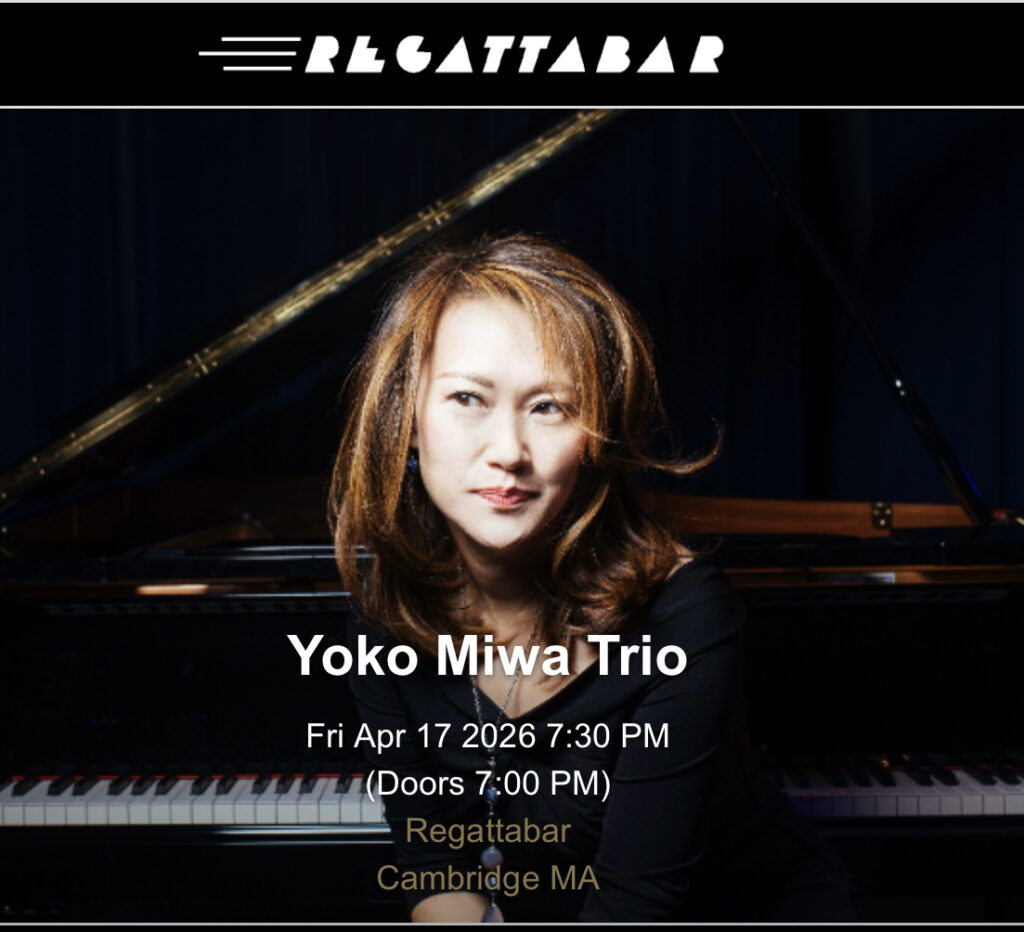
A night out listening to live music is a great way to celebrate a special occasion or just the little things in life, and next week, you can see the Yoko Miwa Trio at The Regattabar in Cambridge – 7:30 pm, Thursday, April 18. If you don’t have your tickets yet, you can get them here.

Yoko Miwa at the Piano

If you don’t have a college acceptance, birthday, anniversary, promotion, or marathon success to toast to at the moment… here are some ideas for what to celebrate:

  • Someone else’s birthday! Haley Mills of Parent Trap fame, for example, was born on April 18. Or, you could treat a friend to the show.
  • If you’re a student or member of the Japanese Association of Greater Boston or the Japan Society of Boston, there are discounts available for your show tickets.
  • In Japan, April 18 is “Invention Day,” honoring the country’s first patent law.
  • On April 18 in 1775, Paul Revere and William Dawes began the famous “midnight ride,” warning Patriots that British Regulars were on their way to capture Patriot leaders. The third “midnight” rider, Dr. Samuel Prescott, joined them at one or two in the morning, after visiting his fiancee. The next day, the American Revolution began.
  • The weather forecast for Boston is in the 50s and 60s all this coming week. Hello Spring!


New Videos

Thursday, April 4th, 2013

Are you subscribed to the Yoko Miwa Trio’s Youtube channel? Half a dozen new videos from the November 2012 performance at Scullers Jazz Club went up this week. The videos include covers of artists from Jimi Hendrix and Neil Young to Thelonious Monk and McCoy Tyner as well as one of Yoko’s original compositions, Flood of Tears.

A limited number of copies of the Trio’s album Act Naturally, released last summer on the Japanese label JVC Victor Entertainment, will be available for purchase at the April 18 show at Regattabar. That show is only two weeks away, so get your tickets now!

Not sure you’re coming to the show? Below are some videos that might change your mind.

Only Love Can Break Your Heart — this song is on Act Naturally


Bossa Beguine


The Most Wonderful Time of the Year?

Thursday, March 28th, 2013

For most of us, the next couple of weeks will bring Easter or Passover, April Fool’s Day, and tax day… events that happen every year. However, for many would-be college and music conservatory students, the next few weeks could be life-changing. At Berklee College of Music, applicants will find out whether they have been accepted by the end of this month! Students will find out whether they have been accepted by the end of March. In addition to being the world’s largest independent music school, Berklee is near and dear to the Yoko Miwa Trio’s hearts. Yoko and Scott both attended Berklee, and Yoko is currently an Assistant Professor there.

One of the most important and nervewracking parts of the Berklee admissions process is the live audition. Auditions take place around the world. They are fifteen minutes long and can include playing a prepared piece, an improvisation section, sight-reading music, and ear training exercises. The school’s website reminds students that they aren’t expected to be perfect at everything, and also reminds them that the interview is just as important a part of the application process!

In the fall, students will arrive in Boston to start their Berklee adventure. They can study performance, jazz composition, music therapy, film scoring… for many young musicians, the long list of possibilities must seem like paradise. All majors at Berklee require at least four semesters of private music instruction, and students who choose the performance major take eight. Piano students have another audition the first week of school – this one, to match them with an instructor who is a good fit for them. Yoko is one of those instructors: rather than teaching classes, she has twenty-five students who take one-on-one piano lessons with her.  On her own faculty page on the Berklee website, Yoko tells students, “No matter what style of music you’re into, the one thing that unifies all of us is our love for music. You are here because music is your life!”

Reflections on Ken Burns’ JAZZ part IV

Thursday, March 21st, 2013

The fourth episode of Ken Burns’ documentary JAZZ begins with the stock market crash of 1929. Jobs were lost, fortunes were lost, and the glitz and glamor of the of the roaring twenties was suddenly very far in the past. The Jazz Age ended when the Great Depression began, but jazz did not. This episode shows how “Jazz would be called upon to lift the spirits and raise the morale of a frightened country.”

Like in so many other eras, people found refuge and joy in music. New York’s popular Savoy Ballroom employed two bands at once so the music never stopped, and the floor was so warn from dancing it had to be replaced every two years. Louis Armstrong played his first gig for a White audience, in the pit for Broadway’s Ain’t Misbehavin’, and audiences called for him to get up onstage. Record companies suffered from hard economic times, but new music was alive, and new audiences listened for free on the radio.

Musician Matt Glaser (who is a colleague of Yoko’s at Berklee College) said of Armstrong’s playing, “This was a new way to experience the modern world and all its hectic movement: just relaxation and freedom. Jazz has been dealing with this concept since Louis made this record, and still to this day.”

It’s true, isn’t it? Music helps us through the problems of every day, whether it’s disturbing events on the news or being late for work and stuck on a jam-packed subway train that isn’t moving. Whether you are listening through headphones throughout your busy day or unwinding by seeing a show, we hope the driving chords and reflective melody of “The Day We Said Goodbye,” or the sparkling trills of “Mr. B.G.,” help you feel the same way, soaring over the hectic parts of life.

Happy Spring, and remember to get your tickets for the Yoko Miwa Trio’s April 18 show at The Regattabar.